Formality of language, power, and African American English

Yesterday, I read Jamelle Bouie’s great article on Slate responding to arguments about the notion of “talking White” (or “acting White”), or the idea that African Americans are opposed to things like ‘standard’ English or even academic success because they are associated, in our collective imagination, with Whiteness.

In particular, he responds to the video below which features an African American woman who takes issue with people who characterize the use of ‘standard’ English as “talking White”.
Read more ›

Tagged with: , , , , , , ,
Posted in Language and race

What to call the Other: A data-driven history of the New York Times’ racial labeling

The word negro makes me uncomfortable. I never hear it, but I occasionally read it. There’s a pretty famous book by sociolinguist Walt Wolfram (Professor of English, North Carolina State University) called A Sociolinguistic Description of Detroit Negro Speech published in 1969. Every time I see the book, the title makes me cringe, but I don’t think Wolfram had any intention to use a word he felt was pejorative. Indeed, he was trying to make the point that African Americans’ speech was not a sloppy, substandard use of language but rather a rule-governed variety of English in its own right. And if you’re not convinced then consider this: in his speech, “I Have a Dream” (delivered in 1963), Martin Luther King Jr. used the term negro fifteen times. I, of course, did not live through the 1960s. I’m part of a generation that seems to have a collective gut feeling that the word is unacceptable.  Read more ›

Tagged with: , , , , , , ,
Posted in Language and race, Media discourse and media bias

We call men abrasive. Except when it matters.

Over the past several months, I’ve been looking at the gendered way we portray leadership qualities. This has included looking at words like bossy and pushy which we assign with much greater frequency to women than men.

Today, I saw a new word pop up in the news, abrasive, thanks to Kieran Snyder’s report examining the different ways in which women and men in the tech industry were described in performance reviews. She found that women generally received more negative feedback from their reviewers. Among the differences was a greater frequency of words commenting on their personal, managerial, or conversational style such as bossy and another that Snyder found particularly interesting: abrasive (the title of her piece for Fortune is “The abrasiveness trap”)In her article, she reports that in the 248 reviews she examined, abrasive was used seventeen times to describe thirteen women but not a single time for a man. Read more ›

Tagged with: , , , , , ,
Posted in Language and gender

Militant, radical, man-hating: How our public discourse describes feminists

When Beyoncé celebrated the word feminist on Sunday night, she was working against a history of celebrities and others rejecting the label feminist. Why do so many women, famous or not, reject the term, while seeming to support the basic principles of feminism? One possible reason is the way the word has been used in the media both traditional media venues and internet websites.

Jessica Bennett asked me about the usage of the word, so in order to examine how feminist has been used by people producing television shows, radio broadcasts, magazines, newspapers, and websites, I looked at the collocates of the word feminist (including related form feminists) using two different corpora. Read more ›

Tagged with: , , , , ,
Posted in Language and gender, Media discourse and media bias

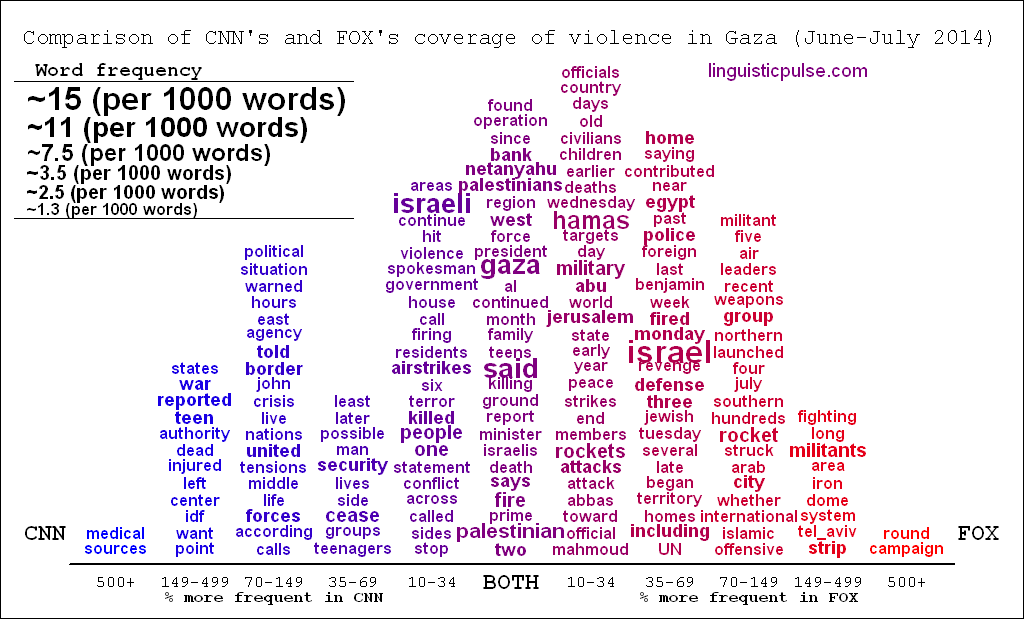
Two tales of Gaza: Comparing FOX and CNN’s coverage of the violence

israel_coverage_linguisticpulse
In the past month we’ve seen the unfolding of another chapter in the bloody conflict between Israelis and Palestinians in Gaza. Since this conflict is, for me and probably many of my readers, taking place halfway around the world, the primary way we come to understand it is through reading accounts of it in news reports. However, even allegedly ‘objective’ news reporting can’t help but make choices that reveal particular ideological biases. Read more ›

Tagged with: , , , , , , , ,
Posted in Language and politics, Media discourse and media bias

Enter your email address to follow this blog and receive notifications of new posts by email.

Join 466 other subscribers