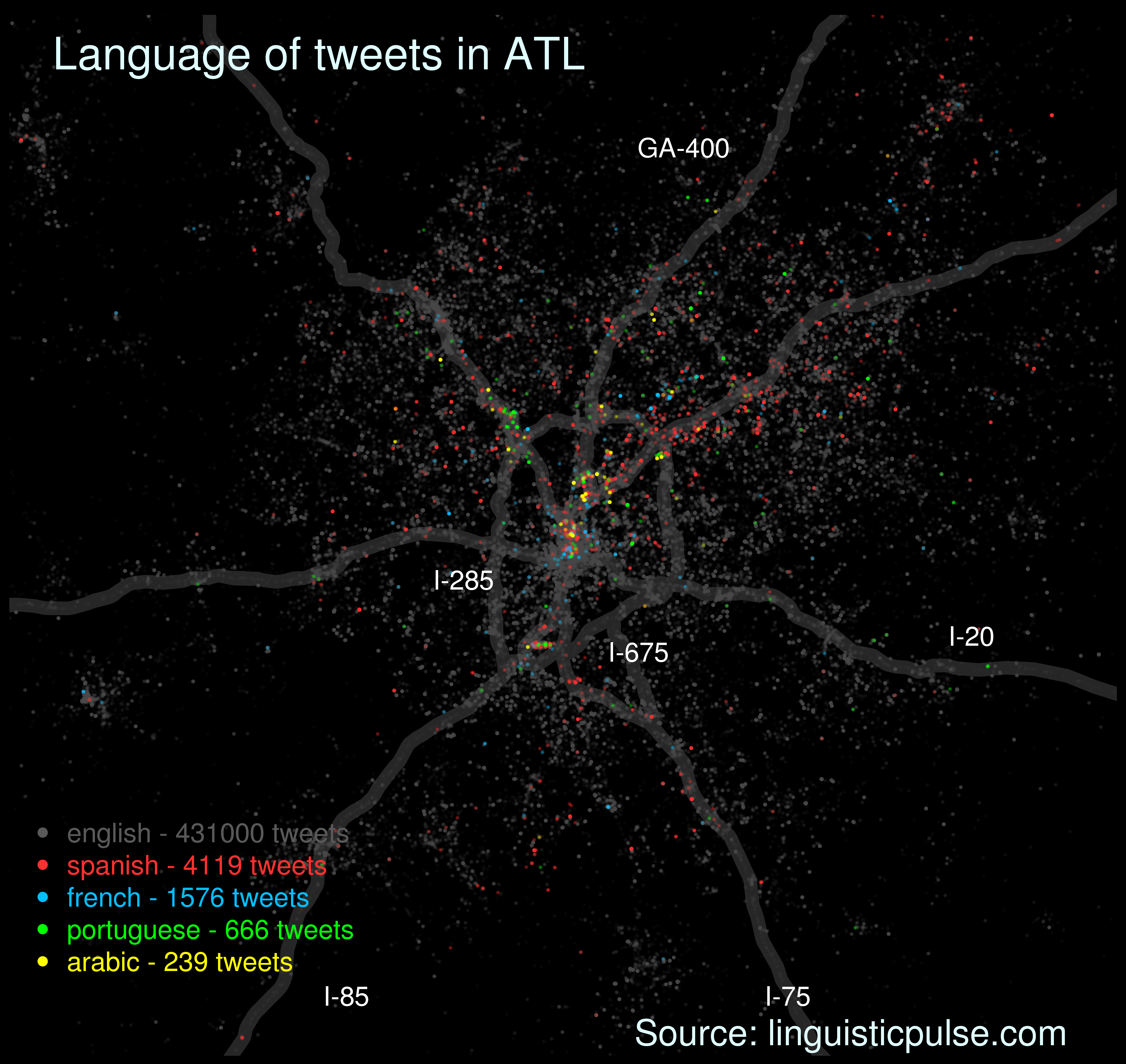
Multilingual Atlanta: Mapping the languages of tweets

Click on the map to see it enlarged in a new tab

This year, I have a research fellowship at my university researching New and Emerging Media. I’ve thus been working on a number of different projects related to computational ways of looking at language and discourse (for example, this one). However, one of the things I’ve been tinkering with has been ways to use the social media platform Twitter to look at language, discourse, and variation. Read more ›

Tagged with: , , , , , , ,
Posted in Human migration, Linguistic diversity, Multilingualism

computer code != human language: Why coding can’t replace language education

So here’s a weird story for you. According to this source (and others), Kentucky state Senator Robert Givens has proposed that, in order to promote computer literacy, high school students should be allowed to use courses in computer programming to satisfy foreign language requirements. New Mexico wasn’t far behind with a similar proposal. Read more ›

Tagged with: , , , , , , , , , , , ,
Posted in Language and education, Technology and language

Habits of the rich: Rationalizing inequality

One striking aspect of contemporary life in the United States (and indeed in many other countries), is the level of material inequality that exists. Such blatant and materially important inequalities demand explanation. Questions like “why do I live in such wealth (or poverty) while others do not?” are ones that call out to be answered any time we are confronted with inequality. As a result, explanations circulate. Read more ›

Tagged with: , , , , , , , , , , , , , , , ,
Posted in Language and social class, Media discourse and media bias

Are you even listening to me?: Miscommunication and the performance of attention

We spend a lot of time talking everyday, much of this in face-to-face communication (yes, even in spite of the rise of digital technologies). When we do so, we rely on the cooperation of another person. One way we expect them to cooperate is to dedicate sufficient amounts of mental energy toward processing our messages so that our speech is not reduced to carbon-dioxide-infused futility. We call this cooperation process “paying attention”. Read more ›

Tagged with: , , , , , , , , , , , , , , , , ,
Posted in Language and gender, Linguistic diversity, Miscommunication and communication difficulties

A prescriptivism with moral and political ends: The linguistic shalts and shalt nots I can get behind

In the field of linguistics, we tend to make a distinction between two ways of thinking about language and grammar: prescriptivism and descriptivism. Read more ›

Tagged with: , , , , , , , , , , ,
Posted in Ideology and social change, Prescriptivism and language prejudice

Enter your email address to follow this blog and receive notifications of new posts by email.

Join 466 other subscribers