What does it mean to be “political”?: Politeness, taboo, and implicit support for the status quo

“When I was a kid, we were taught a few rules among which was never talk about religion or politics in polite company”.

This quote is the first sentence of a 2004 editorial in the Kentucky New Era. The author goes on to admonish the public for the increasingly heated discussion of the Iraq War that she perceives as having permeated into spheres of “polite company”, where apparently such things should not be discussed. Read more ›

Tagged with: , ,
Posted in Language and politics

Google searches reveal stereotypes. Do they also challenge them?

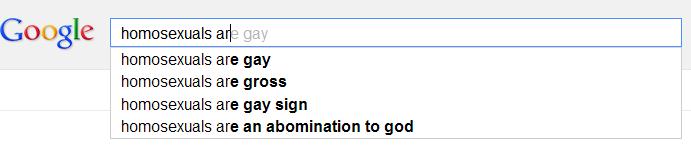
If you’ve ever started typing something into Google and been disgusted by the suggested results, you’re not alone. Take a look at this screenshot from a search I just did:

google_autofill1

The seemingly tautological first result aside (although I think people searching for “homosexuals are gay” might intend ‘gay’ in a derogatory sense), it’s rather disturbing that people have searched so frequently for “homosexuals are gross” that it is Google’s second suggestion. Read more ›

Tagged with: , , , , ,
Posted in Technology and language

“Texting complaints come from stereotypes” printed in Gulf News

A newspaper out of the United Arab Emirates, Gulf News, printed a brief article by me on texting and attitudes toward it. You can check it out here or I’ve posted the original text (before their edits) here Read more ›

Tagged with: , , , ,
Posted in Prescriptivism and language prejudice, Technology and language

Internet explanations for crime: Seriously now, racism isn’t dead

What causes violent crime? It’s an important question, and one that is at the heart of criminology. A large number of factors have been suggested as possible causes and found to correlate with criminal activity (check out this book for a general overview of past research). Among the most important environmental factors are poverty, childhood maltreatment (that is being bullied, neglected, or abused as a child), and low success in school. Some characteristics of individuals also tend to be associated with higher levels of criminality. In particular, if you are any of the following, then you are part of a group with a statistically higher than average tendency to commit crimes: mentally ill (for example, clinically depressed or schizophrenic), male, 20-30 years old, or black. Of course, the first thing I should mention is that correlations are not the same thing as causation. Hence, all or none of these things may actually cause  people to commit crimes. It’s important to realize that the factors are so numerous and their relationships with each other so complex that what the causes of crime really are is incredibly controversial even among the world’s leading researchers.    Read more ›
Tagged with: , ,
Posted in Human migration, Media discourse and media bias, Technology and language

“It’s a tough job, but someone has to do it”: Delusions of grandeur among language elitists

How close would we come to the apocalypse without grammar snobs’ friendly reminders that we don’t use language “properly”? My never-ending fascination with the minds of grammar snobs has led me to an interesting finding. At least in the minds of self-proclaimed authorities on “proper” usage, English and all that it touches would literally burn to the ground without their dependable and well-intended chastisement (by the way, you’re welcome for the use of literally in a figurative context). Read more ›

Tagged with: , , ,
Posted in Prescriptivism and language prejudice

Enter your email address to follow this blog and receive notifications of new posts by email.

Join 466 other subscribers